There was something about the way Mary Ryan facilitated the death doula and soul care course I attended earlier this year that stayed with me. The material was complex, drawing on different religious traditions, spiritual practices and philosophical perspectives, yet she held it with a particular kind of simplicity and spaciousness. We moved fluidly between lenses such as poetry, lived experience, integral theory, Sufism, eco-centric perspectives, and many other different ways of knowing with an ease that made room for both depth and accessibility.
Little did I know, palliative care was only one of many hats Mary wears. A theologian, educator, feminist scholar, Roman Catholic woman priest and soul care practitioner, Mary's work is difficult to locate within any one discipline. Her interests and experiences span feminist theology, hospice care, ancestral healing, ritual, religious studies and the recovery of women's histories. There is a quality of integration in the way she approaches these different fields, not as a project of constructing a singular worldview, but as an ongoing inquiry into what makes us more human.
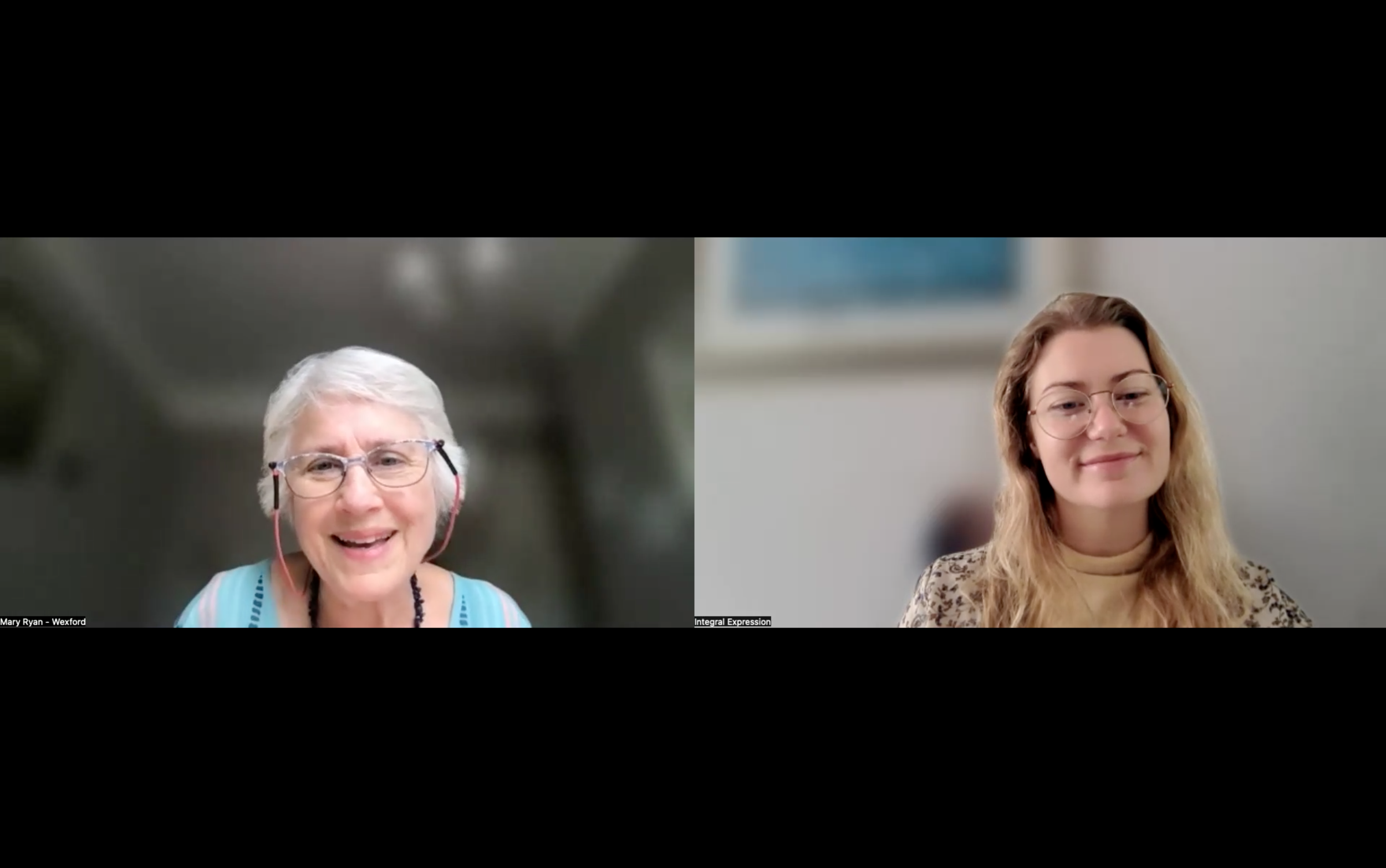
When we spoke, Mary was living in Ireland with her husband (both originally from South Africa) to explore her own ancestral history while continuing to facilitate processes for people seeking to reconnect with their grandmothers’ stories. Our conversation moved between personal stories, institutional histories, spiritual traditions and the practical realities of caring for people at the end of life.
What emerged was a portrait of someone who has spent much of her life entering difficult spaces, questioning the structures within them, and looking for ways to restore what has been marginalised, silenced, excluded or forgotten.
Q: How did you find your way into death care and soul care work?
I suppose I engaged with death work fairly superficially at first, with a sense that it was something I could do with the background I had. There was a space in my life that had opened up. My contract at an academic institution had come to an end, and I was also doing some work on my own ancestors. Things in my family history were presenting themselves as a kind of nudge that I wanted to do something with.
I went to the UK to do some caring work, initially thinking it would be a temporary arrangement. But I discovered that I actually really enjoyed it. It was more than just a stopgap.
When I returned to South Africa, there was an opening at a hospice for someone with a theological background and training experience. I took up the post, which lasted ten months. My daily work involved visiting the wards in the mornings, sitting with people, listening to them and simply being with them. I also trained volunteers from different faith traditions, and some with no particular religious affiliation. Together, we developed a programme of support for people both in the hospice and in their homes.
I realised that my work was probably still in this area of end-of-life care, but that I wanted to bring my teaching background into it. I explored whether I could bring an existing UK-based training programme to South Africa, but it was too expensive and would have needed considerable contextualisation. It wasn't Africanised enough.
So I decided to start something myself. In 2019, I invited a small group of seven women to my home in Woodstock. I had a lovely big open space in the front room, which I turned into a training room. That's where it began.
It felt very right, both for those women and for me. I thought I would simply keep offering it if people continued to show up. And they have ever since.
I think there's something right about the work itself, and about the need at this particular time. Covid certainly impressed upon the world the importance of facing death and dying, and doing some of the preparation work.
Every now and then I think, perhaps this is the last course. I'm not so invested that it has to continue. I don't identify myself entirely with this work. There are many other dimensions to who I am. If this is the last course, then it's the last course. It's done its work. But then another group comes along.
Q: What has your own ancestral search in Ireland revealed, and why has this work become increasingly important to you?
My search for my Irish ancestors began in the 1970s, when I first came here as a student with a backpack. Eventually, I managed to locate my great-grandfather, who had left Ireland in the early 1800s and come to Cape Town. But the rest of his story was very murky. There were records of his descendants in Cape Town, but nothing about him. I found that quite troubling.
I did a lot of research, and eventually consulted a sangoma to explore what might be happening in the family lines at another level, energetically. She pointed towards a potentially troubling narrative.
There were many reasons people left Ireland during that period: poverty, land dispossession, violence, colonial oppression. Some were deported to the colonies for stealing food or livestock. But my great-grandfather didn't seem to fit any of those categories. It was unusual for someone to have come to South Africa at that particular time.
I knew very little about him. He had four children and died quite young in Cape Town.
When I consulted the sangoma again, she suggested that I might never find him in the records, but that his energetic signature was still around. Perhaps it was troubled. Perhaps I needed to restore him to Ireland.
That gave me a very different perspective on why I had come here. Maybe I had known something in my bones that I hadn't understood cognitively.
She suggested that I take some soil from somewhere connected to my family in Cape Town and bring it back to Ireland.
When I was back in Cape Town, I went to the area where my parents had lived and where my family had grown up. I took some soil from there and brought it back. Here in Ireland, where we're living on a lovely piece of land, I held a small ritual and buried it.
It felt as though I was bringing him back to where he belonged, to this land and earth.
And in a way, I've now been able to let go of the quest to find him in the records. There are millions of Ryans. It's a very common name here, like Smith in England. I'm not pretentious enough to think that I'm necessarily going to find him or his ancestors.
But there's a sense of resolution. Whatever was perhaps unhappy or unsettled in his spirit, whatever it was about living in South Africa that meant he wasn't at home, I feel I've honoured that quest. I've done my part.
Something else happened through that process. I had always felt that I wasn't quite at home in South Africa, and I had assumed that feeling belonged to me. But I began to sense that it wasn't actually mine. It was his. And I think I've restored that line.
Q: Tell me more about your particular focus on grandmothers; what do these stories mean to you?
If you think about history, it pays enormous attention to the patriarchal story. The men's stories, particularly those of men who occupied public spaces, are often recorded, acknowledged and honoured. But women's stories are hidden.
I'm becoming more and more interested in this work because I think there is so much to be learned from the women in our histories, both for this generation and for those coming after us.
I've now run seven of these processes. I don't really think of them as courses. They're processes, and they involve engaging the imagination and ritual.
Sometimes we simply don't know. We don't have hard, cognitive evidence. We might have a teacup or a lace doily, something that's been handed down, but we don't have the story. And very often the stories that do survive have been sanitised. So much has been hidden, so many secrets have been kept from view. We may never fully know.
My own spirituality is grounded in the belief that every human being, every living thing, leaves its energetic signature on this earth. That signature is there, and it's accessible if we pay attention at a deep place within ourselves. These processes have emerged from my own search for meaning. There's an integrity in the work because it comes from lived experience, rather than being purely academic. Over the years, I've engaged with the energy fields of my own grandmothers.
My own family history is quite complex. My forefathers came to the Cape in the early 1600s and married slave women. As I studied slavery, I became increasingly aware of how differently women suffered. Sexual abuse and violence were enormous parts of the experience of enslaved women. I suspect many were coerced into relationships with settler men.
How much agency did they have? How much freedom? How much joy? I sat with that pain for a long time and undertook a number of rituals around it.
The women in my family line had come to the Cape from places such as Malaysia and Indonesia. I knew very little about the details of their lives, but the historical records in Cape Town are actually quite remarkable. I've been able to piece together when some of these women were born, where they might have come from and who they might have married.
But, of course, we still don't have their stories. We know something about the loss of their homes, their families and their roots. We can locate them in the records, but we cannot necessarily recover what their lives felt like.
Q: What really struck me on your Soul Care course was how inclusive you were of all religions and spiritual perspectives, seeing the truth in each of them. I would love to hear more about your journey with religion; how did that unfold?
My starting point was very much Catholicism. I grew up in a big Catholic family, my parents were very involved in the Church, and I went to a Catholic school.
Fortunately, university came my way, and it opened up the world.
I went to UCT in the 1970s, when a fairly new course in Religious Studies was being offered. It took a phenomenological approach. Rather than training people for ministry within a particular religion, it looked at religion as a human phenomenon, at why people believe and how religious traditions develop.
I absolutely loved it. What I found so exciting was the openness of the subject. It wasn't about one religion being right. It was about looking at the extraordinary range of ways human beings have understood their relationship with the sacred over centuries and millennia.
That immediately expanded my Catholic worldview. I began travelling, visiting temples and mosques, and engaging with different traditions experientially as well as theoretically.
But then I felt there was another line of inquiry I needed to pursue. Something that had bothered me since I was little was the marginalisation of women.
I went on to do postgraduate work, including a master's and doctorate in feminist theological studies. The question that had always troubled me was: why the misogyny in the Catholic Church? What had driven this treatment of women through the centuries? The silencing, the violence, the exclusion from the sacred?
I explored those questions academically, but eventually found myself asking: I've done the theory, but is there a way to actualise this?
I had always felt a deep calling to the sacred. Since childhood, I had questioned why I couldn't be a priest.
I came across the Roman Catholic Woman Priest movement and began the process of joining it. I travelled to New York to be ordained as a deacon, because that was where the movement was most established, and I wanted to meet other women doing this work.
The following year, in 2014, I was ordained as a priest in the Hemel-en-Aarde Valley in Hermanus.
There is a price to this, of course. The Catholic Church excommunicates women who are ordained outside its structures. I have an official document from the local bishop telling me that I'm excommunicated. Technically, I suppose that means I could go to hell if they have any say over it!
But that's fine. I don't feel excommunicated from God.
There are many things I value in the Catholic tradition. Its contemplative tradition is extraordinarily rich. Its history of morality and ethics, and its commitment to service, justice and equity, are important threads that I'm grateful to have inherited.
But I have very little time for its bureaucracy and rules when they become obstacles to doing good work.
One of the things that strikes me is how the Church can recognise injustice outside itself but struggle to recognise injustice within its own structures. That's perhaps the shadow of all of us, both individually and collectively. We can see what is wrong in the world around us while remaining unable to see the injustice within our own institutions.
Until the Church makes its apology to women for the abuses and exclusions they have experienced through the centuries, I think it will continue to sit with its own suffering and shadow.
Q: Looking back across all these different strands of your life, what do you recognise as the underlying thread beneath it all?
I do think I was born to heal, but probably not in the conventional way.
I have a strong sense that I'm called to work in difficult spaces, to find what is humanising, kind and loving in those spaces, and to free them so that they don't become obstacles to people.
Bureaucracy can be an obstacle. Academia can be an obstacle. If you don't have the right qualifications, for example, you're often excluded from doing good work that you are perfectly capable of doing.
I've realised that I'm not a particularly law-abiding person. I've often subverted authority in my own way, particularly where I think it doesn't make sense.
I do believe in rules when they make sense and when they protect people. But for me, healing and mitigating violence are probably the strongest calls.
What is violent in this situation? What is dehumanising? What is unkind? What might free people?
Those are the questions that have probably driven me, both in my own search for freedom and healing and in the work I've done with others.
It's very much been an inner and an outer journey.
You don't necessarily see the pattern while you're living it. You make choices, you have children, you do the mundane things, you embrace the ordinary parts of life as much as the bigger picture. But as you reflect towards the end of life, you begin to see its own wisdom. You recognise that things have been unfolding in ways you couldn't necessarily have understood at the time.
Q: Has your relationship with purpose changed over the years?
I think I'm no longer on the path of saving the world. That was my trajectory a long time ago. My husband and I were completely idealistic.
When our first son was three months old, we packed him into a very beaten-up old Datsun bakkie and travelled to Lesotho in the middle of winter. My husband was a conscientious objector during apartheid, and the options at the time were jail or leave. So I said, let's leave. We're not going to jail.
We had an opportunity to teach in a rural school in Lesotho, so we went. It was July, it was freezing, it was snowing, and there weren't disposable nappies. I sometimes think about it now and wonder how on earth we did that!
We've had a few adventures.
I think my relationship to purpose has changed over time. Perhaps I've become less attached to the idea of saving the world and more interested in finding meaning and joy in whatever life presents.
Q: What feels most alive for you at this particular stage of your life?
I'm about to head off to my next assignment, which is where my mind is at the moment. I'll be spending two weeks living with someone with very advanced dementia, someone who has very little grip on reality.
My challenge is: how do I work in this space without dehumanising her, but also without dehumanising myself? How do I hold on to my own centre and remain creative and free within, while I'm in the space of someone who has no touchstone with reality?
It's not simply a question of surviving the two weeks. I will survive them. The question is how do I survive them well?
Whatever life throws up, and there are challenges in many different forms, how do we embrace them and see them as opportunities for learning? How do we remain open to the possibility of moments of joy and insight, rather than simply wishing the difficult periods away?
Life is short, and it does feel as though it moves faster as you get older. But I've always enjoyed the different stages of life. I think every stage has something interesting to offer.
Even at this stage, another adventure is always possible.
End of interview
About Dr Mary Ryan
Dr Mary Ryan is a theologian, educator, feminist scholar, Roman Catholic woman priest and soul care practitioner. Her work spans end-of-life care, ancestral healing, ritual and the recovery of women's histories. She began offering her death doula and soul care training in Cape Town in 2019 and is currently based in Ireland, where she continues to explore ancestral memory and facilitate processes centred on reconnecting with forgotten grandmothers.